INTRODUCTION: ENVIRONMENT
The environment includes everything that surrounds us and has an impact on our lives, whether directly or indirectly. It includes live species like plants, animals, and humans, as well as non-living elements like air, water, soil, sunlight, and temperature. All of these components are interrelated, resulting in a balanced system that supports life on Earth.
Humans are an essential part of the ecosystem. However, the ecosystem is suffering as a result of fast population expansion, industrialization, urbanization, and abuse of natural resources. To comprehend these difficulties and discover answers, it is critical to learn the concepts of environment and ecosystems.
ECOSYSTEM
An ecosystem is a self-sustaining functional unit of nature in which living organisms (plants, animals, and microorganisms) interact with one another and with the non-living components (air, water, soil, light, and temperature) of their environment through energy flow and nutrient cycling.
These interactions ensure the flow of energy and the cycling of nutrients, making life possible on Earth.
In simple words, an ecosystem includes plants, animals, microorganisms, and their physical environment working together as a system.
*DIFFERENCE BETWEEN ENVIRONMENT AND ECOSYSTEM
The terms environment and ecosystem are frequently used together, however they do not refer to the same thing. Both are closely similar ideas in the chapter Our Environment, but they have different scopes, structures, and functions.
Environment:
The environment refers to the entire surroundings in which living organisms exist. It includes all living and non-living components that affect life on Earth.
Ecosystem:
An ecosystem is a specific functional unit of the environment where living organisms interact with each other and with non-living components through energy flow and nutrient cycling.
| Basis | Environment | Ecosystem |
| Meaning | Surroundings in which organisms live | Functional unit of interaction between living and non-living components |
| Scope | Broad and extensive | Limited and specific |
| Interaction | Interaction may or may not be direct | Interaction is always present |
| Structure | Includes many ecosystems | Part of the environment |
| Focus | Overall conditions affecting life | Energy flow and nutrient cycling |
| Example | Earth, atmosphere | Pond, forest, aquarium |
# Environment is the whole, and ecosystem is a part of it.
TYPES OF ECOSYSTEM
Based on their origin and characteristics, ecosystems are broadly classified into natural ecosystems and artificial ecosystems.
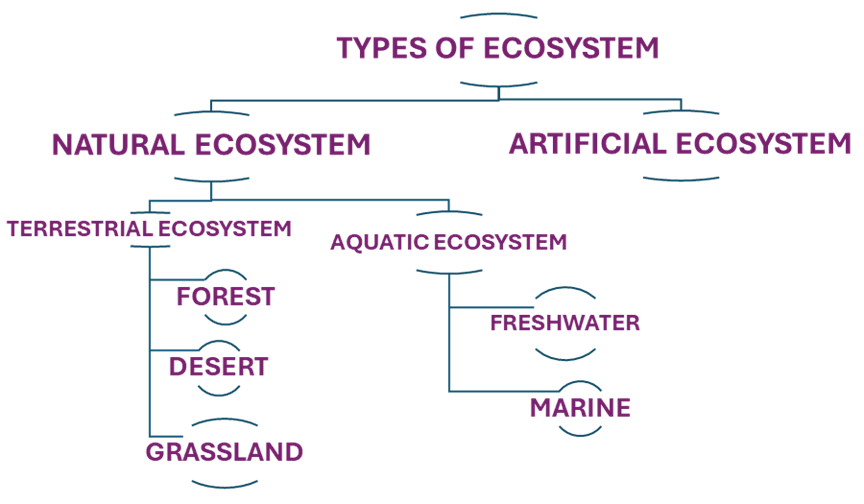
1. Natural Ecosystem
A natural ecosystem is formed by nature without any human intervention. These ecosystems are self-regulating and maintain balance through natural processes such as food chains, energy flow, and nutrient cycling. Natural ecosystems are further divided into terrestrial and aquatic ecosystems.
2. Artificial Ecosystem
An artificial ecosystem is created and maintained by humans to fulfill specific needs. These ecosystems depend heavily on human care and management and cannot sustain themselves naturally for a long time.
Examples of artificial ecosystems include crop fields, gardens, parks, and aquariums. In a crop field, humans decide which plants to grow, provide water and fertilizers, and control pests. Although artificial ecosystems are productive, they usually have low biodiversity compared to natural ecosystems.
TYPES OF ORGANISMS
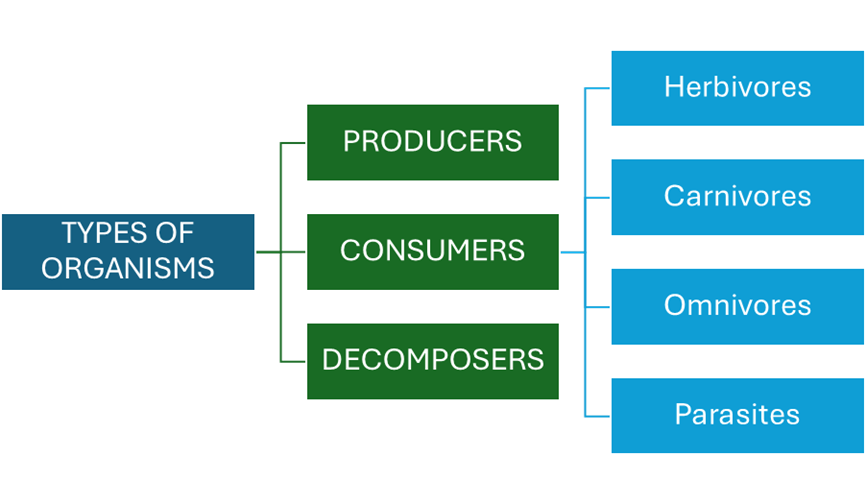
Living species in an ecosystem perform various jobs depending on how they gather energy and nutrients. These organisms are generically classed as producers, consumers, and decomposers. Each species of organism has a distinct purpose, and together they maintain the efficient flow of energy and nutrient recycling in the ecosystem.
1. PRODUCRS
Producers are organisms that can produce their own food from simple inorganic substances. They prepare food by photosynthesis, which uses sunlight, carbon dioxide, and water. Because they produce food for themselves and other organisms, they are the base of all ecosystems.
Green plants are the most common producers. In aquatic ecosystems, algae and phytoplankton serve as producers. Some bacteria can also produce food using chemical energy, a process known as chemosynthesis.
Producers are important because they:
- Capture solar energy and convert it into chemical energy
- Provide food for all other organisms
- Release oxygen, which is essential for life
2. CONSUMERS
Consumers are organisms that are unable to produce their own food and therefore rely on other organisms for energy. They receive their food either directly from plants or indirectly from animals. Some consumers live on or inside other species and get sustenance from them. Consumers are further segmented according to their feeding habits.
a) Herbivores (Primary Consumers):
These organisms feed directly on plants. Examples include deer, cow, goat, and rabbit. They form the second level of the food chain.
b) Carnivores (Secondary and Tertiary Consumers):
Carnivores feed on other animals. Animals like frogs and lizards are secondary consumers, while lions, tigers, and eagles are top consumers.
c) Omnivores:
Omnivores feed on both plants and animals. Human beings, bears, and crows are common examples.
d) Parasites:
Parasites are organisms that live on or inside another organism (host) and obtain food from it, usually harming the host. Examples include tapeworms, lice, ticks, and leeches. Parasites are considered consumers because they depend entirely on other organisms for nutrition.
Consumers are important because they help in:
- Transferring energy from one trophic level to another
- Maintaining population balance in ecosystems
3. DECOMPOSERS
Decomposers are organisms that break down dead plants, animals, and organic waste into simpler substances. Bacteria and fungi are the main decomposers in an ecosystem.
Decomposers are important because:
- Recycling nutrients back into the soil
- Maintaining soil fertility
- Preventing accumulation of dead matter in the environment
Without decomposers, nutrients would remain locked in dead organisms, and the ecosystem would collapse.
FOOD CHAIN
All living organisms require food in order to exist, grow, and carry out life activities. However, no organism lives in isolation. Everyone depends on others for food, either directly or indirectly. The transfer of food and energy from one organism to another creates a food chain.
A food chain is a linear sequence of organisms through which food and energy pass as one organism eats another. It shows who eats whom in an ecosystem and explains the movement of energy from producers to consumers.
In every food chain, energy flows in one direction only, starting from the Sun and ending with top consumers.
Example of a Food Chain
A common example of a food chain is:
Grass → Deer → Lion
In this chain:
- Grass is the producer
- Deer is the primary consumer
- Lion is the secondary/top consumer
This simple chain shows how energy moves from plants to animals.
*Types of Food Chains
Food chains can be of different types depending on the source of energy.
1. Grazing Food Chain:
This food chain starts with green plants and passes energy to herbivores and then carnivores. It is the most common type found in nature.
2. Detritus Food Chain:
This food chain starts with dead and decaying organic matter. Decomposers and detritivores feed on this matter, and energy moves to higher organisms.
*10% LAW
Energy is essential for the survival of every living organism. In an ecosystem, this energy comes from the Sun and travels from one organism to the next via food chains. However, energy is not fully transferred at each stage. This concept is explained by the 10% Law of Energy Transfer, which is a key principle in the chapter Our Environment.
This law was proposed by Raymond Lindeman in 1942. It helps us understand why food chains are short and why the number of organisms decreases at higher trophic levels.
The 10% law states that:
‘Only about 10% of the energy available at one trophic level is transferred to the next trophic level, while the remaining 90% is lost to the environment.’
When organisms consume food, only a small fraction of the energy stored in that food is converted into body mass. The rest of the energy is:
- Used for life processes such as respiration, movement, and growth
- Lost as heat to the surroundings
For example:
Consider a grassland ecosystem:
Sun → Grass → Deer → Lion
- Grass receives 1000 units of energy from the Sun
- Deer gets only about 100 units of energy from grass
- Lion receives only about 10 units of energy from deer
This example clearly shows the gradual decrease in available energy at each trophic level.
*TROPHIC LEVEL
A trophic level refers to each step or position in a food chain or food web where an organism gets its food and energy. The term trophic originates from the Greek word trophē, which means nutrition.
Energy passes from one trophic level to the next, but only a little portion is transmitted each time, which explains why higher trophic levels have fewer creatures.
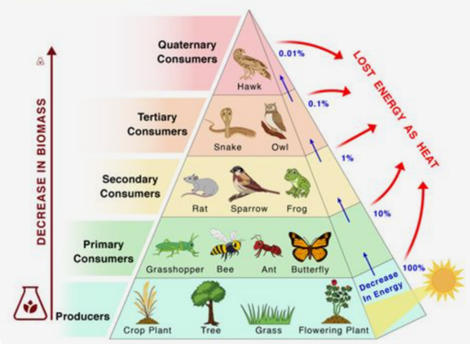
First Trophic Level – Producers
Producers like crop plants, trees, grass, and flowering plants form the base of the pyramid. They make their own food by photosynthesis and store the maximum amount of energy. All other trophic levels depend on producers directly or indirectly.
Second Trophic Level – Primary Consumers
Primary consumers such as grasshopper, bee, ant, and butterfly feed directly on producers. Only about 10% of the energy from producers is transferred to this level, while the rest is lost as heat.
Third Trophic Level – Secondary Consumers
Secondary consumers like rat, sparrow, and frog feed on primary consumers. At this level, only about 1% of the original energy remains, so the number of organisms is reduced.
Fourth Trophic Level – Tertiary Consumers
Tertiary consumers such as snake and owl feed on secondary consumers. They receive very little energy (around 0.1%), which limits their population size.
Fifth Trophic Level – Quaternary Consumers
Quaternary consumers like the hawk are top predators. They receive the least amount of energy (0.01%) and are therefore very few in number.
*FOOD WEB
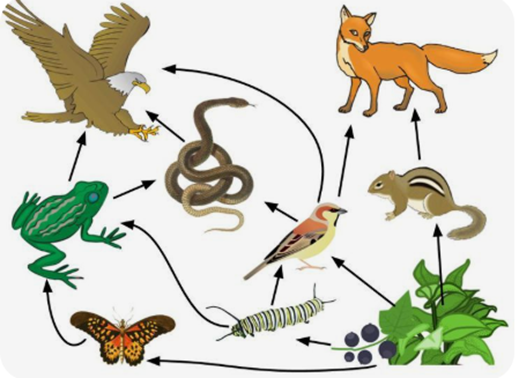
A food web is a network of interconnected food chains that function within an ecosystem. It shows how different creatures are tied to one another via diverse feeding pathways. A food web, as opposed to a food chain, represents various channels for energy transfer.
A single organism in a food web may occupy multiple trophic levels due to its ability to feed on other organisms. For example, a bird may eat both insects and grain. This flexibility improves ecological stability and balance.
*BIOACCUMULATION
Bioaccumulation is the slow accumulation (development) of harmful compounds such as pesticides, heavy metals, and industrial chemicals in the bodies of living organisms. These compounds enter organisms via food, drink, or air and are difficult to digest or eliminate. As a result, their concentration within the organism rises with time.
Bioaccumulation mainly occurs because:
- Toxic substances are non-biodegradable
- Organisms cannot easily remove these chemicals from their bodies
- Pollutants continuously enter the environment
Common substances that cause bioaccumulation include DDT, mercury, lead, and other pesticides.
When a producer absorbs toxic substances from soil or water, these substances enter the food chain. As one organism eats another, the toxins are passed along and accumulate at each trophic level.
Lower organisms may contain small amounts of toxins, but higher organisms store much larger amounts because they consume many organisms from lower levels.
*BIOMAGNIFICATION
Biomagnification means the increase in the concentration of harmful chemicals in living organisms at each higher level of the food chain.
In simple words:
When small organisms eat polluted food and are eaten by bigger organisms, the harmful chemicals keep increasing at every step.
If grass contains a small amount of pesticide:
- 🌿Grass – very small amount
- 🦗 Grasshopper – more amount
- 🐸 Frog – even more
- 🐍 Snake – high amount
- 🦅 Eagle – maximum amount
Thus, the top consumer has the highest concentration of harmful chemicals.
It happens because:
- Non-biodegradable substances (like pesticides, heavy metals)
→ Do not break down naturally. - These substances accumulate in the body fat of organisms.
- When one organism eats another,
→ The chemicals get transferred and increase in amount.
Some common non-biodegradable pollutants:
- DDT (pesticide)
- Mercury
- Lead
- Industrial chemicals
#Note:
- Biomagnification occurs only with non-biodegradable substances.
- It increases at higher trophic levels.
- Top consumers are most affected.
- It disturbs the balance of ecosystem.
Biomagnification is a serious environmental problem where harmful chemicals increase at each level of the food chain. To prevent it, we must reduce the use of harmful pesticides and chemicals and protect our environment.
*HOW DO OUR ACTIVITIES AFFECT THE ENVIRONMENT
1) OZONE LAYER DEPLETION
Ozone Layer:
The ozone layer is a thin layer of ozone gas (O₃) present in the upper part of the atmosphere called the stratosphere. It works like a natural shield that protects living organisms from the Sun’s harmful ultraviolet (UV) rays. Without this layer, life on Earth would not be safe.
Ozone Layer Depletion:
Ozone layer depletion means the gradual thinning or damage of this protective layer. When the ozone layer becomes thin, more harmful UV rays reach the Earth’s surface. These rays can cause serious health and environmental problems.
Causes of Ozone Layer Depletion:
- CFCs (Chlorofluorocarbons) – used in refrigerators, air conditioners and aerosol sprays
- Halons – used in fire extinguishers
- Nitrogen oxides from industries and vehicles
#When CFCs reach the upper atmosphere, sunlight breaks them and releases chlorine atoms. A single chlorine atom can destroy thousands of ozone molecules.
Ozone Hole
A major thinning of the ozone layer has been observed over Antarctica, which is called the Ozone Hole. It was first discovered in 1985 and became a serious global concern.
Effects of Ozone Layer Depletion
When more UV rays reach Earth, it can cause:
- Skin cancer
- Eye problems like cataract
- Weak immune system
- Damage to crops and forests
- Harm to marine life
Prevention and Control
To protect the ozone layer, we must reduce the use of harmful chemicals. Important steps include:
- Using eco-friendly refrigerators and air conditioners
- Avoiding products containing CFCs
- Following international agreements like the Montreal Protocol, which was signed in 1987 to reduce ozone-depleting substances
Conclusion:
The ozone layer is Earth’s natural sunscreen. Ozone layer depletion is a serious environmental issue, but with awareness and responsible actions, we can protect it. Every small step taken today will help in building a safer and healthier future for our planet.
2) MANAGING THE GARBAGE WE PRODUCE
Garbage (waste) is any unwanted or useless material that we throw away after use.
Types of Waste:
- Biodegradable Waste: Waste that can be broken down naturally by microorganisms. Examples: Vegetable and fruit peels, Paper, Leaves, and Food waste.
- Non-Biodegradable Waste: Waste that cannot be broken down easily by microorganisms. Examples: Plastic, Glass, Metals, Polythene.
Way to Manage Waste
- 3R Principle
- Reduce: Reduce the amount of waste we produce. Example: Avoid using plastic bags.
- Reuse: Use items again instead of throwing them away. Example: Reuse glass jars and bottles.
- Recycle: Process waste materials to make new products. Example: Recycling paper, plastic and metals.
- Composting – A Natural Method
- Biodegradable waste can be converted into manure by composting. This reduces garbage and improves soil fertility.
- Government and Public Role
- Segregation of waste (wet and dry waste separately)
- Proper disposal and recycling systems
- Public awareness programs
- Ban on single-use plastics
Conclusion
Managing the garbage we produce is essential to protect our environment. By following the 3R principle and adopting eco-friendly habits, we can reduce pollution and conserve natural resources. Small efforts by each person can bring a big change for our planet.
X————————X————————–X————————X————————X———————-X
Explore other chapter’s NOTES – CLICK HERE or visit Gyanora.in
For Practicing chapter wise question answers – CLICK HERE or visit QnA.Gyanora.in
Follow us on:
YouTube: www.youtube.com/@Gyanora
Telegram: t.me/gyanora
Instagram: https://www.instagram.com/gyan_ora?igsh=aDQxbDk1aDdleHJ6